
The main difference between quartz vs quartzite countertops is that quartz is an engineered surface made from crushed stone and resin, while quartzite is a natural stone formed from sandstone under heat and pressure. Both are durable and attractive, but they differ in maintenance, appearance, and cost.
Quartz and quartzite sound nearly identical, but they are very different materials. This is one of the most common questions homeowners ask when shopping for new countertops, and getting the answer wrong can mean choosing a surface that does not match your lifestyle, your maintenance expectations, or your budget.
Here is a detailed breakdown to help you compare quartz vs quartzite countertops and decide which one is right for your kitchen.
What You Will Learn
- The fundamental difference between quartz (engineered) and quartzite (natural stone)
- How each material compares in appearance, durability, maintenance, and cost
- Which countertop is better for different kitchen styles and daily use
- What real homeowners consider when choosing between the two
- Where to see both materials side by side in Metro Atlanta
Quartz vs Quartzite at a Glance
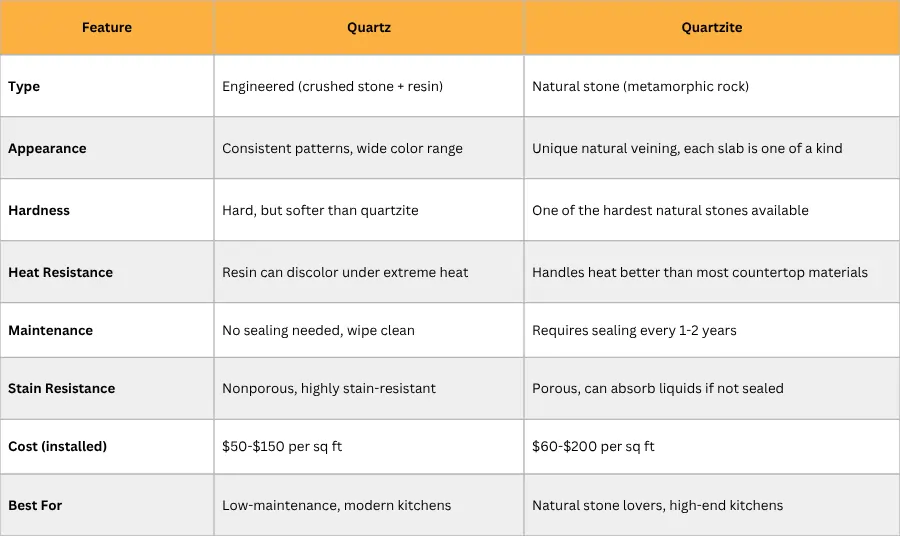
What Are Quartz and Quartzite Countertops?
Despite the similar names, quartz and quartzite are made in completely different ways.
Quartzite is a natural stone. It forms when sandstone is exposed to intense heat and pressure deep underground. Once quarried, it is cut into slabs, polished, and installed as countertops. Because it is a natural material, every quartzite slab has its own unique veining and color variation. No two slabs are exactly alike.
Quartz is an engineered countertop. It is made by combining roughly 90-95% crushed natural quartz with resin binders and pigments. This manufacturing process gives quartz a consistent look from slab to slab and allows manufacturers to offer it in nearly any color or pattern, including styles that mimic natural marble and granite.
When homeowners search for quartzite kitchen countertops, they are looking for a natural stone option with character. When they search for quartz, they want the engineered version that offers more design flexibility and easier upkeep.
How Do Quartz and Quartzite Compare in Appearance?
Quartz offers a wider range of colors and patterns, while quartzite has a more natural, unique look.
Quartzite is typically white to grey in tone, though it can also appear in pink, red, or gold shades due to minerals like iron oxide in the stone. The veining in quartzite is natural and unpredictable, which gives each slab real character. If you want a countertop that feels like a piece of nature in your kitchen, quartzite delivers that.
Quartz, on the other hand, comes in virtually any color. Manufacturers can engineer patterns that mimic marble, granite, or concrete. The look is more uniform and controlled, which appeals to homeowners who want consistency across a large kitchen with multiple countertop sections.
Here is a quick appearance comparison:
- Quartzite: natural veining, mostly white, grey, pink, or gold tones. Each slab is one of a kind
- Quartz: engineered patterns, available in nearly any color or style. Consistent, uniform look from slab to slab
- Quartzite: best appreciated in person because photos cannot capture the depth of the natural veining
- Quartz: what you see in a sample is very close to what gets installed
This is one of the biggest reasons to visit a showroom before deciding. Seeing both materials side by side, under real lighting, makes the difference immediately clear.
How Do Quartz and Quartzite Compare in Hardness and Durability?
On the Mohs hardness scale, quartzite rates around a 7, which is harder than granite. It handles heat exceptionally well, so a hot pan is less likely to cause damage. Quartzite is also highly scratch-resistant.
Quartz is still a very hard material, but because it contains resin, it is more sensitive to extreme heat. Placing a hot pan directly on a quartz surface can potentially discolor or damage the resin. For both materials, using a trivet or hot pad is always the safest practice.
The key durability differences:
- Heat resistance: Quartzite wins. It handles direct heat better than quartz
- Stain resistance: Quartz wins. Its nonporous surface does not absorb liquids
- Scratch resistance: Both are strong, but quartzite edges slightly ahead due to its natural hardness
- Chip resistance: Both can chip on edges if hit hard enough. Proper fabrication and edge profiling reduce this risk
What Maintenance Does Each Countertop Require?
Quartz requires almost no maintenance. Wipe it down with a damp cloth and mild soap. Avoid abrasive cleaners and excessive heat, and the surface stays looking new for years. Because quartz is nonporous, it does not need sealing and naturally resists bacteria and stains.
Quartzite requires more attention. As a natural porous stone, it needs to be sealed when first installed and re-sealed every one to two years. Without sealing, liquids like wine, coffee, and cooking oils can absorb into the surface and leave stains. Once sealed properly, daily cleaning is simple with a gentle stone cleaner.
The maintenance breakdown:
- Quartz: wipe with a damp cloth and mild soap, no sealing ever needed
- Quartzite: seal every one to two years, clean regularly with a pH-neutral stone cleaner
- Quartz: nonporous surface resists bacteria and stains on its own
- Quartzite: porous surface can absorb liquids if the seal wears down
If low maintenance is your top priority, quartz is the easier choice. If you do not mind a little upkeep and love natural stone, quartzite rewards that effort with a surface that gets more beautiful over time.
Cost is one of the most common factors homeowners weigh when comparing quartz vs quartzite countertops.
Quartz typically ranges from $50 to $150 per square foot installed. The price varies depending on the brand, color, pattern complexity, and edge profile you choose. Simpler solid colors tend to be on the lower end, while marble-look veined designs cost more.
Quartzite tends to be more expensive, ranging from $60 to $200 per square foot installed. The higher cost reflects the natural stone quarrying, cutting, and polishing process. Rare colors and exotic veining patterns can push quartzite toward the top of that range.
Factors that affect your final cost for either material:
- Slab thickness: 3cm (standard) vs 2cm
- Edge profile: simple eased edges cost less than ogee or waterfall edges
- Kitchen size and layout: more seams and cutouts add to fabrication time
- Sink cutout style: undermount sinks require more precision
- Removal of old countertops: if replacing existing surfaces
Legacy Countertops offers Synchrony financing for both quartz and quartzite projects, so you can spread the investment over time. Call 678-672-5174 for a free estimate.
How Do You Choose Between Quartz and Quartzite for Your Kitchen?
Choosing between quartz and quartzite comes down to your daily habits, your design preferences, and how much maintenance you are comfortable with. Here is a simple process:
- Decide on maintenance level. If you want a surface you can wipe and forget, quartz is the easier path. If you are comfortable sealing every year or two, quartzite is a rewarding option
- Consider your budget. Quartz generally costs less, but both materials have a wide price range. Get a quote for your specific kitchen layout and preferred material
- Think about your kitchen style. Quartzite’s natural veining suits homeowners who want something organic and unique. Quartz’s consistent patterns work well for modern, minimalist, or uniform designs
- See both materials in person. This is the step most people skip and later wish they had not. Photos and samples only tell part of the story. The depth, texture, and light interaction of each material is something you need to experience at full slab scale
- Ask about your specific kitchen. Factors like heat exposure near the stove, sink placement, and how many seams your layout requires all influence which material performs better in your space
Both are excellent long-term investments. The right choice depends on what matters most to you.
What Do Metro Atlanta Homeowners Say About Their Countertops?
With over 433 Google reviews at an Excellent rating, Legacy Countertops hears directly from homeowners about what they love about their quartz and quartzite surfaces long after installation day.
Customers consistently mention a few things that set the experience apart:
- Guidance on material selection. Choosing between quartz vs quartzite countertops can feel overwhelming. Our design consultants, including Valleria, Vanesa, and Kamilla, walk homeowners through the real-world differences between each material based on their kitchen, their cooking habits, and their style preferences. These consultants are mentioned by name in dozens of reviews
- Seeing the actual slab before it is cut. For quartzite especially, this matters. Since every natural slab is unique, picking your own slab means you know exactly what your countertop will look like. No surprises
- Honest recommendations. Our team has been fabricating and installing both quartz and quartzite across Metro Atlanta since 2010, completing 30+ projects every week. When one material is a better fit for your kitchen than the other, we will tell you.
When Should You Talk to a Countertop Specialist?
Researching quartz vs quartzite countertops online gives you a strong foundation. When you are ready to get specific about your kitchen, a conversation with a specialist helps you narrow it down. Consider reaching out if:
- You want to compare quartz and quartzite slabs side by side in person
- Your kitchen layout has angles, islands, or multiple seam points that affect material choice
- You are unsure how heat exposure near your stove or cooktop impacts your decision
- You want an accurate cost comparison based on your specific project size and edge profile
- You are also considering granite or marble and want to see all your options
Frequently Asked Questions
Quartz is an engineered countertop made from about 90-95% crushed quartz mixed with resin and pigments. Quartzite is a natural stone formed when sandstone is exposed to extreme heat and pressure underground. Quartz offers more color options and does not need sealing, while quartzite has a unique, natural look but requires regular maintenance.
Quartzite is harder than quartz and handles heat better, making it less likely to scorch from hot pans. However, quartz is more resistant to staining because its surface is nonporous. Both are strong and long-lasting, but each excels in different areas of durability.
Both work well in kitchens, but the best choice depends on your needs. Quartz is ideal if you want low maintenance, stain resistance, and a wide range of colors. Quartzite is better if you prefer a natural stone look and do not mind sealing it every one to two years.
Yes, quartzite countertops need to be sealed when first installed and re-sealed every one to two years. Sealing protects the porous surface from absorbing liquids, stains, and bacteria. Quartz countertops never need sealing because the resin binder makes them nonporous.
Quartz countertops typically range from $50 to $150 per square foot installed. Quartzite tends to be more expensive, ranging from $60 to $200 per square foot, because of the natural stone quarrying, cutting, and polishing process. Final costs depend on slab thickness, edge profile, and installation complexity.
Quartzite handles heat better than quartz and is less likely to be damaged by hot pans. Quartz contains resin that can discolor or crack under extreme heat. For both materials, using a trivet or hot pad is recommended to protect the surface and keep it looking its best.
Both quartz and quartzite countertops can last 20 to 30 years or more with proper care. Quartz requires less upkeep to maintain its appearance, while quartzite needs regular sealing to stay protected. Either option is a long-term investment that adds value and beauty to your kitchen.
Ready to Compare Quartz and Quartzite in Person?
The best way to choose between quartz and quartzite is to see them side by side at full slab scale. Legacy Countertops in Alpharetta carries both materials in our showroom, with design consultants who can walk you through the differences based on your specific kitchen.
Schedule a free consultation or call us at 678-672-5174. Email: Sales@LegacyCountertops.com