
If you have been researching marble countertops for your kitchen or bathroom in Atlanta and Alpharetta, you have probably come across the word etching. It is one of the most common concerns homeowners raise when considering marble, and understanding what it is, what causes it, and how to handle it makes all the difference in whether marble is the right choice for your home.
Etching is surface damage on natural stone caused by a chemical reaction between acid and the calcium in the stone. It looks like a dull mark, a ring, or a hazy spot that will not wipe away with regular cleaning. It is not a stain. It is a physical change to the surface of the stone itself.
Here is everything you need to know about marble etching, from causes and severity to repair and prevention.
What You Will Learn
- What marble etching is and why it happens
- The common household items that cause etching
- How to identify minor, moderate, and severe etch marks
- Step-by-step repair options based on severity
- Daily habits that prevent etching on marble countertops
- Whether marble is the right material for your home if etching concerns you
What Causes Etching?
Marble is a calcium-based stone. When an acidic substance touches the surface, it reacts with the calcium carbonate in the marble and dissolves a thin layer of the stone. That dissolved layer is the etch mark. Even spills that are wiped up quickly can start the reaction, and the longer the acid sits on the surface, the deeper the damage goes.
Common household items that cause marble etching:
- Lemon and lime juice
- Vinegar
- Tomato sauce and salsa
- Coffee and wine
- Orange juice and other citrus drinks
- Fresh fruit left sitting on the counter
- Harsh chemical cleaners (bleach, ammonia, bathroom sprays)
- “Natural” cleaning products that contain citric acid
The key thing to understand is that sealing your marble does not prevent etching. Sealers protect against stains by reducing liquid absorption, but they do not block the chemical reaction that causes etch marks. This is one of the most misunderstood points in marble countertop care.
How Severe Can Marble Etching Get?
Not all etch marks are the same. Severity depends on the strength of the acid and how long it was in contact with the marble surface.
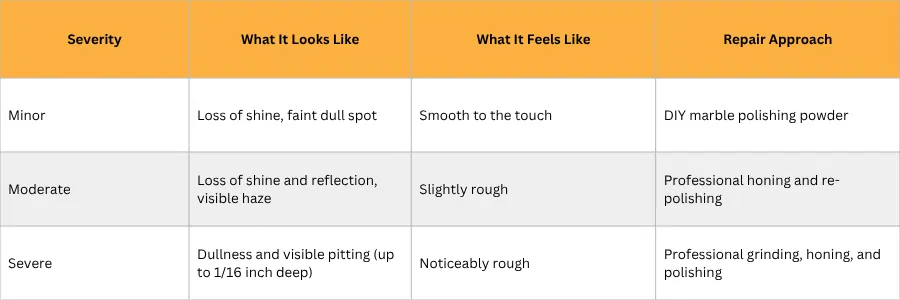
Minor etch marks are the most common in everyday kitchen use. A splash of lemon juice wiped up within a few minutes will usually leave a faint dull spot that can be buffed out at home. Moderate and severe etching typically results from prolonged exposure or stronger acids left on the surface.
How Do You Repair Marble Etch Marks?
Minor etching (DIY):
- Apply a marble polishing powder or cream designed for natural stone to the dull spot
- Buff the area with a soft cloth using firm, circular motions
- Wipe clean and check the shine. Repeat if needed
- This works best on polished marble finishes
Moderate etching (professional):
A stone restoration specialist can hone and re-polish the affected area. This involves lightly sanding the surface with progressively finer abrasives until the shine returns. The surrounding area is blended, so the repair is not visible.
Severe etching (professional):
Deep pitting requires professional grinding to remove the damaged layer, followed by honing and polishing to restore the surface. This is less common in residential kitchens but can happen if a strong acid like vinegar or citrus cleaner pools on the marble for an extended time. If you are in the Metro Atlanta area and need professional marble restoration, a local stone specialist familiar with the climate and common stone types in Georgia homes will give you the best results.
Important: etching is not a stain. Poultices and stain removers will not fix etch marks. If the dull spot does not respond to polishing powder, the damage is likely moderate or severe and needs professional attention.
How Do You Prevent Marble Etching?
Prevention comes down to daily habits. Marble is a beautiful, timeless material, and homeowners who follow a few simple practices keep their surfaces looking great for years.
Daily prevention habits:
- Wipe up spills immediately, especially anything acidic
- Use coasters under glasses for coffee, wine, juice, and cocktails
- Place cutting boards down when slicing citrus, tomatoes, or anything acidic
- Clean with a pH-neutral stone cleaner or mild dish soap and warm water
- Avoid all-purpose cleaners, vinegar-based cleaners, and anything with citric acid
- Keep fresh fruit in a bowl or on a tray rather than directly on the marble
Ongoing marble maintenance:
- Apply a quality stone sealer every 6 to 12 months. Sealing prevents stains but does not prevent etching
- Consider a honed (matte) finish for your marble instead of polished. Honed marble still etches, but the marks are far less noticeable on a matte surface
- For high-traffic kitchens, keep a marble polishing powder on hand for quick touch-ups on minor etch spots
Marble countertop maintenance is straightforward once you build these habits. Homeowners across Roswell, Johns Creek, and Sandy Springs who have chosen marble for their kitchens will tell you the same thing: the stone rewards the care with a look that no engineered material can replicate.
Should You Choose Marble If Etching Is a Concern?
This is the question most homeowners are really asking when they research marble etching. The answer depends on what matters most to you.
Marble offers a warmth, depth, and character that no other countertop material matches. The veining, the soft tones, and the way it ages over time give it a timeless quality that homeowners love for decades. Many homeowners accept minor patina and etching as part of marble’s natural character, similar to the way hardwood floors develop character over time.
If low maintenance is your top priority and the idea of any surface marks concerns you, there are alternatives worth seeing in person:
- Dolomite looks similar to marble with soft white and gray veining, but it is more resistant to acid etching. It is a natural stone that gives you a marble-like aesthetic with better durability against everyday kitchen acids
- Quartzite offers a natural stone look with significantly more hardness and resistance to both scratching and etching than marble
- Quartz is an engineered surface that is nonporous and completely resistant to etching. Marble-look quartz designs have become very realistic
- Granite is also more resistant to etching than marble, though it does require periodic sealing
At Legacy Countertops in Alpharetta, we carry all five materials in our showroom specifically because this decision comes down to seeing and feeling the stone in person. Every homeowner’s tolerance for maintenance is different, and comparing marble next to dolomite, quartzite, quartz, and granite side by side is the most effective way to decide. Our team has been guiding Metro Atlanta homeowners through this exact choice since 2010, and the right answer is different for every kitchen.
Visit our showroom at 5872 Atlanta Highway, Alpharetta, GA 30004 to see all five materials and compare them under real lighting. Call 678-672-5174 or email Sales@LegacyCountertops.com to discuss your project.
Frequently Asked Questions
Marble etching is surface damage that occurs when acidic liquids or foods react with the calcium carbonate in marble. It shows up as dull marks, rings, or hazy spots that cannot be wiped away with regular cleaning.
Acidic substances cause marble to etch. Common culprits include lemon juice, vinegar, wine, coffee, tomato sauce, and harsh chemical cleaners. Even brief contact can start the etching process.
Yes. Minor etch marks can often be buffed out at home using marble polishing powder. Moderate to severe etching typically requires professional stone restoration, which may involve honing and re-polishing the surface.
Prevent etching by cleaning spills immediately, using pH-neutral cleaners, placing coasters and cutting boards on the surface, and sealing your marble every 6 to 12 months. Choosing a honed finish can also help hide minor etch marks.
No. Sealing protects marble from stains by reducing liquid absorption, but it does not create a barrier against chemical reactions. Acidic substances can still etch a sealed marble surface.\
No. A stain is a discoloration caused by a substance soaking into the stone, while etching is physical damage to the surface caused by a chemical reaction. Stains can often be drawn out with a poultice, but etching requires polishing or professional repair.
Many homeowners choose marble for its timeless beauty, unique veining, and warmth that no other material matches. With simple daily habits and realistic expectations, marble looks beautiful for years. If low maintenance is your top priority, dolomite, quartzite, quartz, or granite may be a better fit. Seeing all options side by side at a showroom is the best way to decide.
Ready to See Marble in Person?
Visit our showroom at 5872 Atlanta Highway, Alpharetta, GA 30004 to compare marble against dolomite, quartzite, quartz, and granite. Call 678-672-5174 or email Sales@LegacyCountertops.com to get started on your project.