
Granite vs quartz countertops is the most common comparison homeowners research when planning a kitchen remodel. After designing, fabricating, and installing thousands of granite and quartz countertops across Metro Atlanta since 2010, our team at Legacy Countertops walks customers through this exact comparison every week.
The biggest difference is that granite is 100% natural stone, quarried in full slabs with unique veining and color. Quartz is an engineered surface made from roughly 90-94% crushed quartz mineral bonded with resin and pigments. Both are durable, long-lasting, and popular for kitchen remodels, but they differ in maintenance, appearance, and cost.
What You Will Learn
- The fundamental difference between granite (natural stone) and quartz (engineered surface)
- How each material compares in appearance, durability, maintenance, and cost
- The pros and cons of each countertop material for everyday kitchen use
- What the countertop installation process looks like from start to finish
Granite vs Quartz at a Glance
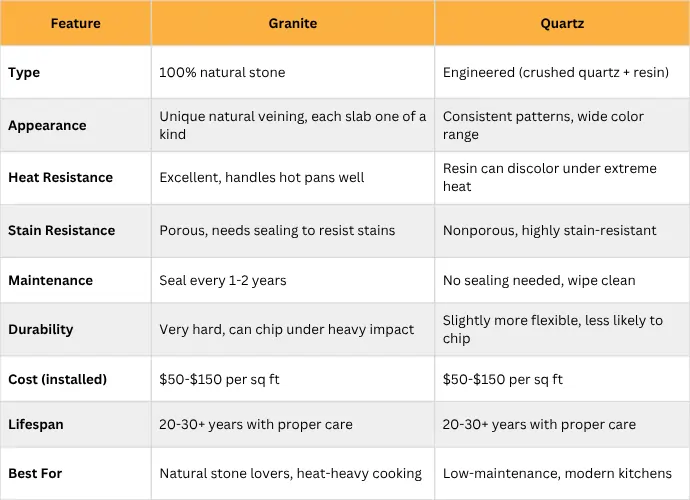
What Is the Difference in Material Makeup Between Granite and Quartz?
The major difference between granite and quartz begins with how each material forms.
Granite is 100% natural stone. It forms deep underground from cooled magma, and each slab is quarried as a single piece of rock. Nothing is added to the material. The colors, patterns, and veining you see in granite are entirely natural, formed by minerals such as feldspar, mica, and quartz within the stone itself.
Quartz countertops are engineered. They are made by combining roughly 90-94% crushed natural quartz with resin binders and pigments. The manufacturing process allows quartz to be produced in a wide range of colors and patterns, including designs that mimic marble, granite, and concrete. The result is a consistent, uniform surface from slab to slab.
Both materials are heavy and require professional installation. The weight and rigidity of granite and quartz slabs demand precise measurement, cutting, and handling.
How Do Granite and Quartz Compare in Appearance?
Appearance is often the deciding factor for homeowners choosing between granite vs quartz countertops.
Granite offers a completely unique look. Because it is natural stone, no two slabs are exactly alike. The veining, color depth, and mineral flecks create patterns that cannot be replicated. Granite is available in a wide range of natural colors, from classic blacks and whites to exotic blues, greens, and golds. If you want a countertop with real character, granite delivers that.
Quartz offers more design control. Manufacturers can produce virtually any color or pattern, from clean solid whites to bold marble-look veining. The look is consistent from slab to slab, which works well for large kitchens where multiple countertop sections need to match seamlessly.
A key difference for shopping:
- Granite: best appreciated in person because the depth and movement of the stone cannot be captured in photos
- Quartz: what you see in a showroom sample is very close to what gets installed
For granite especially, visiting a showroom and selecting your actual slab matters. The piece you choose is the piece that goes in your kitchen.
Which Countertop Material Is More Durable?
Both granite and quartz are built to last, but they handle different types of stress differently.
Granite is extremely hard and handles heat exceptionally well. You can set a hot pan on granite without worrying about scorching or discoloration. However, granite can chip or crack under heavy impact, especially along edges and corners.
Quartz is slightly more flexible because of the resin binder, which makes it less likely to chip or crack from impact. However, quartz is more sensitive to extreme heat. Placing a very hot pan directly on a quartz surface can potentially discolor or damage the resin. For both materials, using trivets and cutting boards is always the safest practice.
Which Countertop Material Requires Less Maintenance?
Quartz requires almost no maintenance. Wipe it down with a damp cloth and mild soap. Because it is nonporous, it does not need sealing and naturally resists bacteria, stains, and liquid absorption. Avoid abrasive cleaners and extreme heat, and the surface stays looking new for years.
Granite requires a bit more attention. As a natural porous stone, granite needs to be sealed when first installed and re-sealed every one to two years. Without proper sealing, liquids like wine, coffee, and cooking oils can absorb into the surface. Once sealed, daily cleaning is simple with a gentle stone cleaner or warm soapy water.
For busy households with kids or heavy cooking schedules, quartz is the lower-effort choice. If you do not mind a simple annual seal and prefer the look and feel of natural stone, granite is well worth the upkeep.
How Much Do Granite and Quartz Countertops Cost?
Cost is a major factor in the granite vs quartz countertops decision, and the good news is that both materials fall in a similar price range.
Granite typically costs $50 to $150 per square foot installed. The price depends on the slab origin, rarity of the color, thickness, and edge profile. Standard colors like Uba Tuba or Santa Cecilia tend to be on the lower end, while exotic slabs with rare veining or coloring cost more.
Quartz also ranges from $50 to $150 per square foot installed. Simpler solid colors are more affordable, while marble-look veined designs from premium brands tend to be at the higher end of the range.
Factors that affect your final cost for either material:
- Slab quality and rarity: exotic or premium slabs cost more
- Edge profile: simple eased edges cost less than ogee, bullnose, or waterfall designs
- Kitchen size and layout: larger kitchens with islands, L-shapes, or multiple seams add to fabrication time
- Sink cutout style: undermount sinks require more precision than drop-in
- Removal of existing countertops: demo and disposal may add to the project cost
How Do You Choose Between Granite and Quartz for Your Kitchen?
Choosing between granite and quartz comes down to your cooking habits, your design preferences, and how much maintenance you are comfortable with. Here is a step-by-step process:
- Think about heat exposure. If you frequently set hot pans on the counter or cook with high heat near the countertop surface, granite handles that better
- Decide on maintenance level. If you want a surface you never have to seal, quartz is the easier choice. If annual sealing does not bother you, granite is a perfectly manageable option
- Consider your design style. Granite’s natural veining gives kitchens a warm, organic feel. Quartz’s consistent patterns suit modern, minimalist, or uniform designs
- Compare in person. This step matters for both materials but especially for granite. Since every granite slab is unique, seeing the actual slab that will go in your kitchen is important. Quartz samples are more representative of the final product
- Factor in your full project scope. If you are also replacing backsplash, sinks, or edge profiles, discuss the full picture with your fabricator to get an accurate cost and timeline
What Does the Countertop Installation Process Look Like?
Legacy handles granite and quartz projects under one roof, from showroom selection through installation. The typical flow:
- Consultation and slab selection. Visit our Alpharetta showroom to choose your material. For granite, you pick the actual slab that will be installed in your kitchen.
- Laser templating and fabrication. We measure on-site for an exact fit, then cut and finish your slab in our own facility.
- Professional installation. Typical turnaround is 7 to 10 business days from template to install.
Frequently Asked Questions
Both granite and quartz can increase your home’s resale value. Granite is often viewed as a premium, luxury material by buyers. Quartz is increasingly popular for its modern look and easy upkeep. Either option is a strong investment for a kitchen remodel.
Granite is the better choice for outdoor kitchens, grill stations, and fireplace surrounds. It handles direct sun, heat, and weather well when sealed. Quartz is not recommended for outdoor use because UV exposure can discolor the resin binder over time. For covered patios or shaded outdoor areas, granite is the safer pick.
Ready to Compare Granite and Quartz in Person?
The best way to decide between granite and quartz is to see both materials at full slab scale under real lighting. Legacy Countertops in Alpharetta carries both in our showroom, and our team can walk you through the differences based on your specific kitchen.